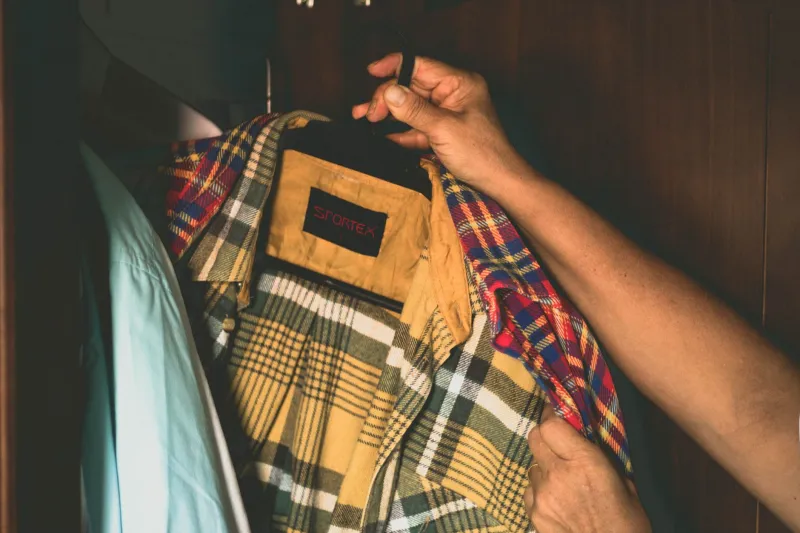
Let's be real for a second. At some point in the last few years, getting dressed started feeling less like self-expression and more like homework. There's always a new microtrend cycling through your feed, a fresh aesthetic with a name you have to Google, and an unspoken pressure to look like you're keeping up. It's exhausting. And somewhere in all that noise, a lot of us quietly stopped dressing for ourselves.
But here's the thing — choosing to ignore all of that? That's not laziness. That's a choice. And it's a more powerful one than it looks.
The Algorithm Didn't Build Your Wardrobe. Or Did It?
Fast fashion and social media have always had a cozy relationship, but it's gotten uncomfortably tight. Platforms now function as trend accelerators, pushing aesthetics from niche corners of the internet into mainstream consciousness in a matter of days. What starts as someone's genuine personal style gets flattened into a consumable product — then packaged, mass-produced, and sold back to you before you even had a chance to decide if you actually liked it.
The result? A lot of closets full of stuff that made sense in the moment but doesn't quite feel like you. Pieces bought because they were everywhere, not because they sparked anything real. And a subtle but persistent anxiety that your personal taste is somehow always one step behind.
This is by design. The business model of fast fashion depends on you feeling like you're never quite current enough. The moment you feel settled in your look, a new wave rolls in. It's not a coincidence — it's the whole game.
What "Dressing for Yourself" Actually Means
It sounds simple. Maybe even a little cliché. But dressing for yourself is genuinely harder than it sounds when you've spent years absorbing external signals about what's acceptable, cool, or on-trend.
It doesn't mean rejecting everything popular or going out of your way to be contrarian. It means slowing down enough to ask: Do I actually like this, or do I like that other people like this? That's a surprisingly tough question to answer honestly.
For a lot of Zaraco customers, that shift happened gradually. One woman, a graphic designer based in Austin, described it as a "wardrobe detox" — she spent a weekend pulling out everything she owned and asking herself when she'd last reached for each piece without thinking twice. The stuff she grabbed instinctively, without second-guessing, told her more about her actual style than years of intentional shopping had.
Another customer, a guy in his early 30s from Chicago, said he realized he'd been dressing for his office's idea of "smart casual" for so long that he'd completely lost track of what he'd wear if there were no context to dress for. It took a solo trip out west — no meetings, no expectations — to figure it out.
Neither of those stories is dramatic. But both of them describe a real recalibration. A return to something personal.
The Psychology Behind Wearing What You Actually Want
There's real research behind the confidence boost that comes from wearing clothes that feel authentic to you. Psychologists have a term for it — enclothed cognition — which refers to the way clothing influences the wearer's psychological state. When what you're wearing aligns with your self-concept, you move differently. You feel more settled. Less like you're performing something and more like you're just... present.
On the flip side, wearing something that doesn't feel like you — even if it's technically on-trend or objectively well-made — creates a low-grade friction. You're aware of it all day. You adjust, you second-guess, you don't quite feel like yourself. It's the sartorial equivalent of a song stuck in your head that you don't even like.
The brands that understand this aren't chasing hype cycles. They're building pieces with enough character to actually mean something to the person wearing them — without being so loud that they wear the person instead of the other way around. That balance is harder to find than it sounds.
Why This Is Actually Rebellious
Here's where the "radical" part comes in. Consumer culture — especially in fashion — is built on insecurity. Not the dramatic kind, but the low-level, ambient kind that keeps you scrolling, comparing, and buying. The entire marketing apparatus is calibrated to make you feel like your current self is slightly insufficient and your next purchase is the fix.
Opting out of that loop — even partially, even quietly — disrupts the system in a real way. When you stop buying things because they're trending and start buying things because they genuinely fit your life and your aesthetic, you're no longer a reliable consumer. You're a discerning one. And discerning consumers are, frankly, less profitable for brands that rely on churn.
That's not a call to boycott anything or go full minimalist if that's not your vibe. It's just worth recognizing that the simple act of pausing before you buy, asking yourself if something actually speaks to you, and walking away when it doesn't — that's a form of resistance. Small, quiet, and genuinely effective.
Building Your Own Visual Language
The most interesting dressers aren't necessarily the ones wearing the most expensive or the most avant-garde pieces. They're the ones whose style feels coherent — like it's telling a story that belongs to them specifically. You can clock it immediately. There's a consistency that doesn't come from following a formula; it comes from paying attention to yourself over time.
Building that kind of personal visual language takes patience. It means trying things, keeping what resonates, and being willing to let go of what doesn't — even if it was expensive, even if it got compliments, even if you thought it was supposed to be your thing.
At Zaraco, that's the kind of style we're actually interested in. Not the version that looks like everyone else's curated feed. The version that looks like you — specific, considered, and unapologetically yours.
And honestly? That's the boldest thing you can put on.