Dress Scared, Change Everything: What Happens to Your Brain When You Take a Style Risk
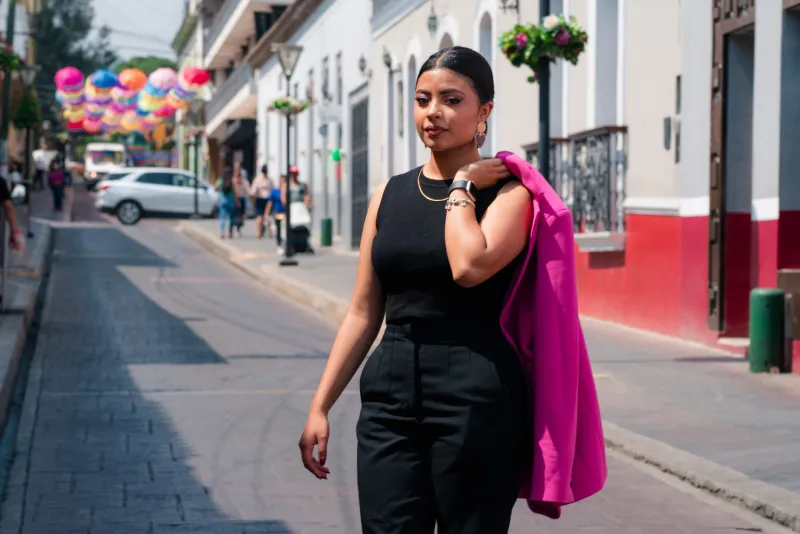
The first time Maya wore the coat, she almost turned around and went back upstairs to change.
It was a deep emerald green, structured at the shoulders, with oversized buttons that felt almost theatrical. She'd bought it on a Tuesday after seeing it on a mannequin and experiencing what she described as "a feeling I couldn't justify." It sat in her closet for three weeks before she finally wore it out on a random Wednesday morning.
"I felt like everyone was looking at me," she said. "And then I realized — they were. And it was fine. Better than fine, actually."
By the end of that day, something had shifted. Not dramatically, not permanently, not in some movie-montage way. But a little. Enough to notice.
This kind of experience isn't unique to Maya. It's not even particularly unusual. It's actually backed by a growing body of research on the relationship between clothing, cognition, and behavior — and it suggests that what you wear isn't just a reflection of who you are. It's a tool for becoming who you want to be.
The Science Has a Name
Researchers call it enclothed cognition — the idea that clothing influences the psychological processes of the person wearing it, not just the perceptions of the people observing it. A landmark study from Northwestern University found that wearing a garment associated with certain qualities (like focus, authority, or confidence) actually produced measurable improvements in the wearer's performance on tasks requiring those qualities.
In other words, the clothes aren't just signaling something to the outside world. They're signaling something to you.
When you wear something that feels bold, unfamiliar, or outside your usual aesthetic comfort zone, your brain registers the difference. You become slightly more alert to your own presence. You move a little differently. You make decisions — small ones, like how you hold yourself in a meeting, or whether you speak first in a conversation — that compound in interesting ways over time.
Why Discomfort Is Actually the Point
Here's where it gets counterintuitive. The mild discomfort you feel when you wear something that scares you a little isn't a sign that you made the wrong choice. It's a sign that you're doing something your nervous system recognizes as a stretch — and stretches are exactly how behavioral patterns change.
Psychologists who study habit formation and personal agency talk about a concept called behavioral activation — the idea that action often precedes feeling, not the other way around. You don't wait until you feel confident to act confident. You act confident, and the feeling follows, because your brain updates its model of who you are based on what you do.
Dressing boldly is a low-stakes version of this. You're not skydiving. You're not quitting your job. You're putting on a statement piece and walking out the door. But the neural pathway you're activating — the one that says I can do something that feels uncomfortable and survive it — is the same one that gets stronger every time you use it, regardless of the context.
That's not a small thing. That's actually kind of a big deal.
Real People, Real Shifts
Derek had been wearing variations of the same outfit for most of his adult life. Dark jeans, solid-color tee, neutral sneakers. Safe, functional, invisible by design. He worked in tech in San Francisco, where the unofficial uniform is practically mandated, and he'd never thought much about it.
Then a friend convinced him to try a brand that made graphic-forward pieces with bold color blocking — the kind of thing he'd always dismissed as "not for him." He bought one shirt. Wore it to a casual Friday at the office.
"Three people came up to me and started conversations," he said. "Not about the shirt, necessarily — just conversations. I think I seemed more approachable. Or maybe I was more approachable. I'm not sure there's a difference."
He now describes his style as "intentional" — a word he never would have applied to it before. The shift didn't happen because he became a different person. It happened because one small act of visible self-expression opened a door he didn't know was there.
Jordan's story is different but rhymes with Derek's. She spent years defaulting to all-black everything — not because she loved it, but because it felt safe. "I didn't want to be wrong," she said. "Like, stylistically wrong. I thought if I just wore black, no one could criticize my choices."
The irony she eventually recognized: that strategy was its own kind of statement, and it was one that said I'm not sure I'm worth noticing. The day she wore a patterned midi skirt in a bold floral print to a job interview — an interview she got, for what it's worth — she said something clicked. "I walked in there feeling like myself. That's the only way I can describe it."
The Zaraco Principle
At Zaraco, the whole philosophy orbits around this idea: that dressing with intention and a little audacity isn't vanity. It's a practice. It's something you can do every single morning that has real downstream effects on how you experience your day, how you show up in your relationships, and how you build your sense of self over time.
Bold style isn't about wearing the loudest thing in the room. It's about wearing something that's genuinely, authentically you — even when that feels vulnerable. Especially when that feels vulnerable.
How to Start Without Overhauling Everything
If the idea of a total style overhaul feels paralyzing, good news: that's not what this requires. The research on behavioral change consistently supports small, incremental steps over dramatic reinventions. Here's how to introduce a little productive discomfort into your wardrobe without going off the deep end:
Start with one piece. One bold item worn with your usual rotation is enough to change the energy of an outfit. A statement shoe. A textured jacket. One piece of jewelry that actually says something.
Wear it somewhere low-stakes first. A grocery run. A coffee shop. A casual weekend outing. Let your nervous system get used to the experience before you wear the thing to your performance review.
Notice what happens. Not what other people say — what you feel. How do you walk? How do you make eye contact? What's different about how you carry yourself? That data is more valuable than any compliment.
Repeat. The discomfort shrinks with repetition. What felt like a risk at first becomes your new normal, which means your baseline for self-expression has expanded. That's the whole point.
Who You're Becoming
Every outfit is a small act of self-definition. It's a choice you make about what version of yourself you're going to inhabit today. And while no single clothing choice will transform your life, the cumulative effect of choosing intentionally — of choosing boldly — adds up to something real.
Maya still has the green coat. She wears it all the time now. It doesn't feel scary anymore. It just feels like her.
That's the thing about dressing scared. You only have to be scared the first time.